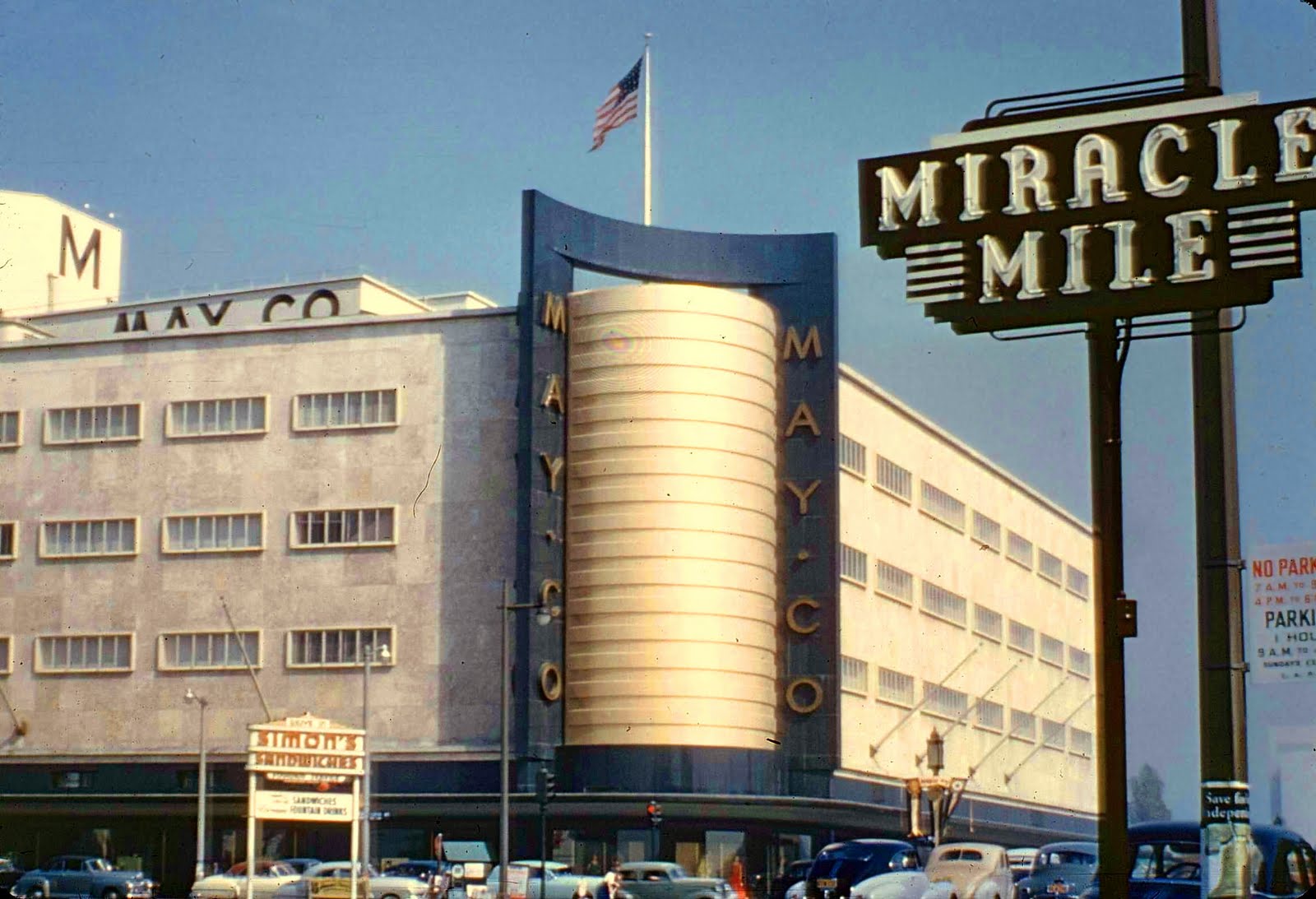
A History of Miracle Mile
In order to understand the historical and cultural significance of Miracle Mile, one needs to look back to the teachings of the past and see how in such a short span of time, a truly unique and distinctive culture has been forged in the midst of one of the country’s darkest moments.
1920’s America saw some of the most prolific and most devastating events in our nation’s history. Los Angeles at this time was a thriving Metropolis, boasting some of the most well known characters in history as its residents and civic leaders. Its streets were filled with an ambiance of prosperity and wonder. Its architecture took on a new form, embracing the wealth and new "Moderne" culture that was a result of "the good times."
The Miracle Mile was just an 18 mile stretch of oil rig-dotted terrain. The first Spanish Governor Felip De Nev described it as a "lake of pitch and water" uninhabitable by anyone (La Brea tar Pits). One man however had a vision, a vision that was soon to become the very representation of the city’s recovery from the great depression. His name was A.W. Ross. Ross purchased the land in 1920 for $54,000, and planned to turn it into a center for the emerging banking industry in Los Angeles. As self imposed lead supervisor in every project constructed on the mile in his time, Ross capitalized on the architectural advancements popularized by the expositions at the Chicago’s World Fair. The architectural accents were made to embody the feeling of prosperity and financial stability that was becoming Los Angeles. Unique details, accents, and innovative construction methods were used in the construction of each building making each a literal work of art. Each building’s developers strived to make their project more unique and "moderne" than the previous. As a result, a new era of style was born. We affectionately know it to be Art Deco.
The "greatness" of the mile, as it was described by Ross, was a direct relation to the roaring twenties. The Mile quickly became a center for business as well as the arts. It was not uncommon to see the families of businessmen parading the streets, shopping in its many boutiques and what came to be known as department stores.
Life for Angelino’s could not have been better on the mile. Money was abundant, culture was thriving, and new innovations quickly turned the Mile into a landmark in Los Angeles’s skyline.
That all came crashing down on the darkest day in America’s history, the great depression. A once proud and prosperous country found herself in the grips of economic downfall. Men once proud and prominent found themselves selling all of their personal treasures for pennies on the dollar, just to feed their families, and ensuing debts.
The Mile was not exempt. A stretch of land embodying all that was the heart and soul of Angelinos became dormant. Buildings went vacant, residents moved to the outskirts of the city, and it looked like it was the end of Ross’ dream of a financial and cultural center.
It was not until 1934 when the financial institutions went into overdrive. Massive civic projects were authorized by congress, and locally, they were to be financed by the money men on the mile. Freeways, bridges, street paving, civic centers, parks, and golf courses became the new industry of the financial institutions on the mile. Jobs were re-acquired, wealth redistributed, and the country had seen the light at the end of an abysmal tunnel. The men on the mile were the ones bringing it to the masses. Miracle mile was well on its way back to the "greatness" of which it had been known as a beacon.
It is because of this resilience in adverse situations that Miracle Mile is what it is today. The Mile attracts those who are placed in adverse situations, and have the drive and desire to pull themselves out, just like the mile itself. It is now home to not only the most respected financial institutions in the world, but a wide range of other professional industries that revolve around the concept of advancement, and prosperity. Its ornate buildings have become a reminder of times past, obstacles overcome, and the resilience of the human condition.
It has been said that Miracle Mile residents have no age. By this, I mean that a person of 90 years can have the same sense of awe and respect for the "greatness" of the Mile, as a person of 20 or 30. The very nature of the mile speaks loudly to anyone who has experienced a hardship, and feeds their souls with hope and a sense of purpose. While it is not for everyone to reside, the mile can be enjoyed by all that ever ask the question "why is my world the way it is today?" It is only those lucky few who do live here that can truly feel as if they are a part of something bigger and greater than themselves. That sense is ageless, and will be shared by future generations to come.
Enjoy these links of useful information about the cultural diversity that is the Miracle Mile. When you look through them, try and remember a time that may have past chronologically, but is still alive and well in our hearts, in our minds, and in my restored buildings. From all of us here at Art Deco Apartments, good luck and help us keep the dream alive so that our future generations can ask the question, and learn the answer by those who have lived it.
Sincerely,
Dave Goldstein
Miracle Mile Links
LaBrea Tar Pits
George C. Page Museum houses one of the world's largest collections of Ice Age fossils, adjacent to LACMA.
El Ray Theatre
The El Rey Theater is an original art deco theater in the heart of Miracle Mile, one of L.A.'s preserved art deco districts. Built in 1936, designed by Clifford Balch. Registered historical landmark.
Los Angeles County Museum of Art
The L.A. County Museum of Art is the largest art museum west of the Mississippi.
Jan Baum Gallery
End the day in the La Brea Ave-Beverly Blvd area to explore the Jan Baum Gallery which features emerging L.A. artists.
Vintage L.A.
Get a peek at Los Angeles in the post war era. Great collection of vintage pictures of a time that will not be forgotten.
Petersen Automotive Museum
At the corner of Fairfax Ave and Wilshire Blvd, the Petersen Automotive Museum is much more than a vintage car collection.